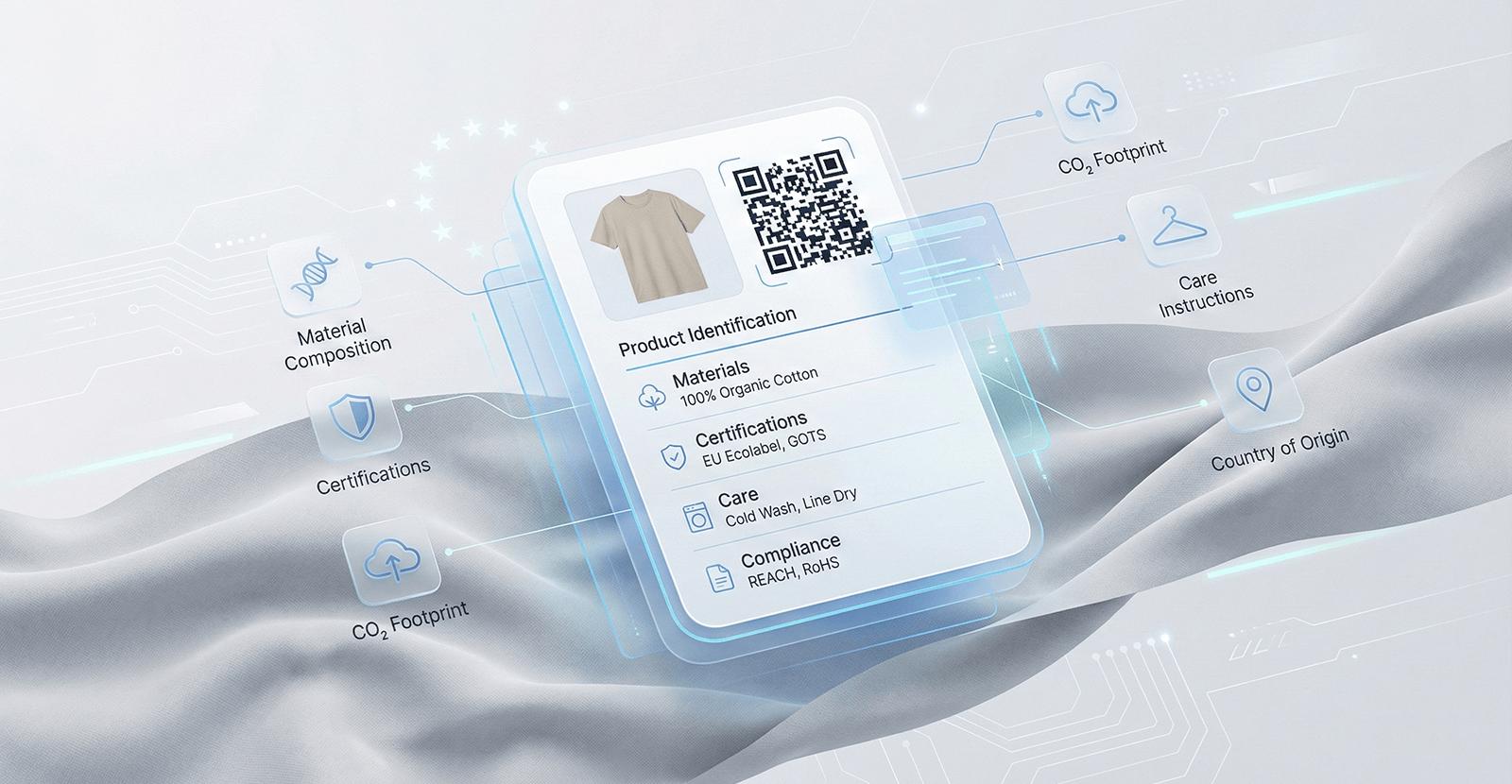
The EU's Digital Product Passport (DPP) for textiles is coming. While the exact requirements will be finalized when the ESPR Delegated Act is published (expected late 2026/early 2027), manufacturers need to start collecting data now. This guide explains what data you need to collect and who can access it — whether you're producing finished garments or supplying raw materials and components.
Important: This guide is based on current CIRPASS recommendations, EPRS research, and our implementation experience. Final requirements will be confirmed in the official Delegated Act. Fluxy.One will update this guide as regulations evolve.
Why Two Sections: NOW vs. LATER? EU regulations will roll out in stages. We organize data fields by when you'll likely need them:
- NOW (2027) - Start collecting these fields for mandatory compliance when DPP becomes required.
- LATER (2030+) - Not mandatory yet, but strongly recommended by experts. Prepare now to stay ahead. This phased approach helps you prioritize: focus on essential fields first, then expand as requirements evolve.
Understanding Access Levels DPP data has different access levels depending on who's viewing it:
- Public - Anyone who scans the QR code (consumers).
- B2B - Your customers, suppliers, business partners (restricted access).
- Authorities - Regulators, customs, market surveillance (full access). Not all data is public. Some information is restricted to protect business confidentiality.
PART 1: Essential Data - Collect NOW Start collecting these fields immediately. These will be required when DPP becomes mandatory (expected 2027).
1. Product Identification
- Manufacturer: Who made this product - company name and details (Access: Public)
- Brand Name: The brand selling the product (Access: Public)
- Country of Origin: Where the product was made (single country) (Access: Public)
- Product Name: What the product is called (e.g., "Cotton T-Shirt") (Access: Public)
- Category: Type of product (shirt, pants, dress, etc.) (Access: Public)
- Size: Product size (S, M, L, EU 38, etc.) (Access: Public)
- Product Image: Photo of the actual product (Access: Public)
- Color: Product color name (Access: Public)
- Description: Brief product description (Access: Public)
- Manufacturer Logo: Company/brand logo image (Access: Public)
2. Unique Identifiers
- GTIN (Global Trade Item Number): 13 or 14-digit product identifier (barcode number) (Access: B2B + Authorities)
- GLN (Global Location Number): Standardized location identifier for your facilities (Access: B2B + Authorities)
- SKU (Stock Keeping Unit): Your internal product code (Access: B2B)
- Production Date: When the product was manufactured (Access: Public + B2B + Authorities)
- Batch Number: Production batch/lot identifier (Access: B2B + Authorities)
3. Manufacturer Information
- Organization Name: Full legal name of manufacturer (Access: Public)
- Organization Address: Manufacturing facility address (Access: Public (country only) + Authorities (full address))
- Contact Point: How to reach the manufacturer (email, phone) (Access: Public)
- Manufacturer Website: Company website URL (Access: Public)
4. Material & Composition
- Material Composition: What the product is made of (e.g., "95% Cotton, 5% Elastane") (Access: Public)
- Fiber Content: Detailed fiber breakdown with percentages (Access: Public)
- Chemicals Used: List of chemicals used in production (Access: Authorities only)
- REACH Compliance: Confirmation that product meets EU chemical safety regulations (Access: Public + Authorities)
5. Care & Durability
- Care Instructions: How to wash, dry, and maintain the product (Access: Public)
- Warranty Period: How long the warranty lasts (Access: Public)
6. Compliance & Certifications
- REACH Compliance: Full REACH compliance documentation (Access: Authorities only)
- Azo Dyes Free: Confirmation that no harmful azo dyes were used (Access: Authorities only)
- Regulations Compliance: Compliance with all relevant EU regulations (Access: Authorities only)
- Certifications: List of certifications (GOTS, OEKO-TEX, Fair Trade, etc.) (Access: Public)
- Certificate Number: Certification reference numbers (Access: Public + Authorities)
7. Safety & Disposal
- Disposal Instructions: How to properly dispose of or recycle the product (Access: Public)
- Recycling Instructions: Step-by-step recycling guidance (Access: Public)
- Contact for Disposal: Who to contact about recycling/disposal (Access: Public)
- Safety Data Sheet: Technical safety documentation (Access: Authorities only)
PART 2: Extended Data - Prepare for Later These fields aren't mandatory yet but are strongly recommended by experts. Start collecting now to stay ahead.
8. Recycled Content
- Recycled Content Total: Total percentage of recycled materials in the product (Access: Public)
- Post-Consumer Recycled / Pre-Consumer Recycled: Percentages from waste and production (Access: Public/B2B)
9. Additional Durability Information
- Expected Lifetime: (years/uses) (Access: Public)
- Is Repairable / Recyclable: Yes/No indicators (Access: Public)
- Durability Score / Repairability Index: (Access: Public)
10. Environmental Impact
- Carbon Footprint / GHG Emissions / Water & Energy Consumption / Biodiversity Impact (Access: Public/B2B)
11. Supply Chain Traceability
- Material Traceability / Supplier Information / Origin Verification / Shipment Tracking (Access: Public/B2B)
12. Circularity Features
- Take-Back Program / Reusability Potential / Material Recovery Rate / Verification Hash (Access: Public/Authorities)
13. Additional Identifiers
- Serial Number: Individual item number (Access: B2B + Authorities)
Two Types of DPP: Finished Products vs. Raw Materials
Finished Products (Garments, Clothing) You need all the fields listed above, with focus on consumer-facing information. Key priorities:
- Care and recycling instructions (customers need this)
- Material composition and certifications (transparency)
- Complete supply chain links (from farm to finished garment)
- Environmental impact (carbon footprint, water usage)
Example: A brand producing t-shirts creates one DPP per GTIN (style + color). When customer scans QR code, they see composition, care instructions, brand story, recycling info.
Raw Materials (Fabrics, Yarns, Components) You need similar fields but with different emphasis. Key priorities:
- Material composition and chemical safety (your customers need this)
- Batch/lot tracking (critical for traceability)
- Technical specifications (B2B data)
- Links to your suppliers' DPPs (upstream traceability)
Example: A fabric mill produces organic cotton jersey. Each production lot gets a DPP. When garment manufacturer receives fabric, they can access the DPP and link it to their finished product DPP.
How Data Flows in Textile Supply Chain
- Step 1: Cotton farm creates DPP → Origin, farming practices
- Step 2: Spinning mill receives cotton, creates yarn DPP → Links to cotton DPP
- Step 3: Weaving mill creates fabric DPP → Links to yarn DPP
- Step 4: Garment factory creates finished product DPP → Links to fabric DPP
- Step 5: Brand publishes DPP with QR code → Consumer scans and sees full chain
Each step adds information and links to previous DPPs, creating complete transparency from source to consumer.
Where to Get This Data
Already Have It:
- Product name, size, color → Your product database
- Care instructions → Your care labels
- Certifications → Quality control files
- Manufacturer info → Company registration
- Production dates → Manufacturing records
Need to Request from Suppliers:
- Material composition → Fabric supplier specifications
- Recycled content percentages → Supplier declarations
- Chemicals used → Supplier REACH documentation
- Origin verification → Supplier certificates
- Upstream DPP links → Supplier DPP systems
Need to Calculate:
- Carbon footprint → LCA tools (Higg Index, PEFTrust, Footbridge)
- Water usage → Production data + calculation tools
- Environmental score → PEF methodology
- Durability ratings → Testing + analysis
Access Control: Who Sees What?
Public (Consumers scan QR code) Can see:
- Product name, brand, image, description, size, color
- Material composition and fiber content
- Care and recycling instructions
- Country of origin
- Certifications (GOTS, OEKO-TEX, etc.)
- REACH compliance confirmation
- Warranty information
- Environmental impact (when available: carbon footprint, water usage)
- Recycled content totals
- Durability and repairability information
- Take-back programs
Cannot see:
- Internal codes (GTIN, SKU, batch numbers)
- Supplier names and addresses
- Detailed chemical lists
- Business-to-business data
- Technical compliance documents
B2B (Business Partners with Authentication) Can see everything public, PLUS:
- GTIN, SKU, GLN, batch numbers, serial numbers
- Production dates
- Supplier information and traceability links
- Pre-consumer recycled content breakdown
- Shipment tracking
- Material traceability (links to supplier DPPs)
- Energy consumption data
- Supply chain events
- Biodiversity impact assessments
Cannot see:
- Authorities-only compliance documentation
Authorities (Customs, Regulators, Market Surveillance) Can see everything, including:
- All compliance documentation
- REACH detailed reports and chemical lists
- Azo dyes compliance
- Full manufacturer addresses
- Safety data sheets
- All audit trails
- Verification hashes
Getting Started
- Step 1: Review the data fields Go through Part 1 (Essential Data) and identify what you already have in your systems.
- Step 2: Check what you have Most businesses already have 50-70% of required data in existing systems (ERP, PLM, PIM, quality control).
- Step 3: Request missing data Contact suppliers for material specs, recycled content, REACH compliance, and origin documentation.
- Step 4: Choose a DPP platform Use a service like Fluxy.One to organize, manage, and publish your DPP data with proper access controls and QR code generation.
Common Questions
Q: Do I need a DPP for every single item I produce?
A: For mass production: one DPP per GTIN. For luxury: one per individual product.
Q: My suppliers don't have this data yet. What should I do?
A: Start with what they can provide. Make DPP data a requirement in new purchase orders.
Q: How do I protect confidential business information?
A: Use access control levels. Fluxy.One manages this automatically (Public/B2B/Authorities).
Q: Can I use my existing product database?
A: Yes! Most DPP data exists in ERP/PLM/PIM. Fluxy.One integrates with these systems.
Q: Do raw material suppliers need DPPs too?
A: Yes. Fabric and yarn suppliers need DPPs so finished product manufacturers can link to them.
Ready to Move Beyond Theory? Stop reading regulations and start implementing. Book a free consultation to see the Fluxy.One platform in action and secure your zero-fine guarantee.
Small Brand? Future-Proof Your Sales with ZeroBox
Are you a small manufacturer focused on online sales and capsule collections? Don't let upcoming regulations overwhelm your budget. With ZeroBox by Fluxy.One, you can get a perpetual GS1 Digital Link for free, right now. It’s the "anti-bureaucratic" way to secure your product’s future—start for free and add compliance data only as you grow and as the law requires.
Exporting from Central Asia? Secure Your EU Access via Tashkent
If you are a manufacturer in Central Asia, you don’t need to build complex supply chain tracking systems to stay compliant. Fluxy.One’s Tashkent office provides a pragmatic, cost-effective solution to ensure your products cross the EU border without issues.
More..
The 2026–2030 ESPR Working Plan
Digital Product Passport (DPP) for Textiles: Guide for Exporters and Importers (2025–2028)
Fluxy.One - Mindful. In your Flow. Sincerely.
Enterprise & Importers
Book a free consultation to secure your EU market access.
Book Free DemoBrands & Exporters
Selling into the EU and unsure which product groups need a Digital Product Passport, or by when? Get a readiness check and a clear compliance path — no guesswork.
Free consultation