The question everyone is asking wrong
By now, most brand owners selling into the EU have heard of the Digital Product Passport. Some have attended a webinar. Some have read a guide. A few have even started talking to vendors.
And yet the most common feeling at the end of that process is not confidence. It's a vague, unresolved anxiety: I know I need to do something, but I don't know if what I'm doing is the right thing.
That's because almost everything written about DPP readiness answers the wrong question. It answers "why should you prepare?" The answer everyone already knows. What brands actually need is an answer to a different question: how do I know if I'm on the right track?
Readiness is not a platform you buy. It's not a date in your calendar. It's a state of your data – and most brands, when they look honestly, discover that state is worse than they thought.
Here are three questions that will tell you where you actually stand.
Three questions that actually matter
1 - Do you know the composition of every product you sell – in a structured format, not in a PDF from the factory?
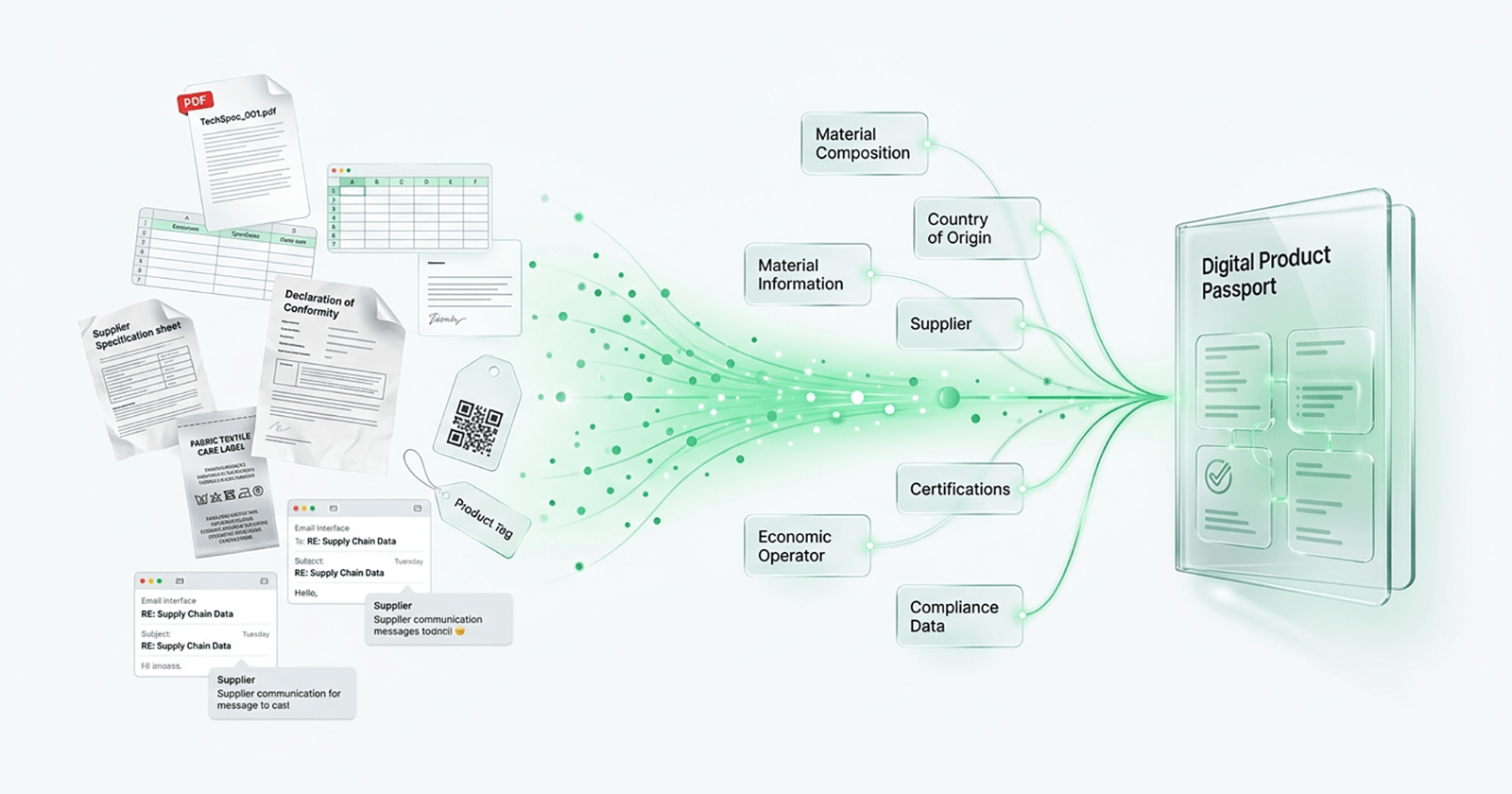
This is where most brands discover their first gap. They have a technical datasheet somewhere. Their supplier sent it over when they placed the first order, possibly years ago, probably as a PDF, possibly in a language they had to translate. That document exists. But it is not data.
A Digital Product Passport requires machine-readable, structured information: fibre composition by percentage, country of origin, chemical compliance status, repairability information. Not a scan of a document. Not a spreadsheet someone filled in by hand from memory. Structured, updatable, verifiable data that a system can read and a regulator can audit.
If your honest answer to this question is "we have documents but not data," you've found your first gap.
2 - Do you know who is legally responsible for your DPP on the EU market?
Under ESPR (Regulation (EU) 2024/1781), the obligation falls on the economic operator – the entity placing the product on the EU market. For an EU-based manufacturer, that's the manufacturer. For a brand that produces outside the EU and imports, that's the EU importer. If neither applies, the obligation can be assumed by an authorised representative – but that arrangement must be explicit, documented, and the representative takes on full accountability.
This sounds administrative. In practice it creates a surprisingly common situation: a brand sells into Germany through a distributor, assumes the distributor handles compliance, and no one has actually checked who the economic operator is. When the DPP registration requirement hits – starting with the Battery Regulation (EU) 2023/1542 from 18 February 2027, and then rolling out across textiles and other categories as delegated acts are adopted under the ESPR Working Plan (COM(2025)187 final), expected from 2027 – that ambiguity becomes a blocker.
If you don't know who your economic operator is, you cannot register a single DPP. That question needs an answer before anything else.
3 - Could you collect all the data for one product – right now, this week?
Pick your simplest product. The one with the fewest components, the clearest supply chain, the most straightforward composition. Now try to gather everything a DPP would require: materials, percentages, country of manufacture, supplier name and location, care instructions, end-of-life guidance, any relevant certifications.
This exercise is not about building a DPP. It's about diagnosis. If you can do it for one product in a day or two, you're in a reasonable position. If it takes two weeks and three rounds of emails to a factory that doesn't respond quickly, you've just discovered exactly what your DPP implementation challenge looks like – before a deadline is forcing you to solve it.
Practical shortcuts – from Dominik Davydau, Head of R&D at Fluxy.One
Collecting product data sounds like a months-long project. It doesn't have to be. Here are four approaches that save time without cutting corners.
Use AI to extract data from physical labels and documents. Take photos of your product labels, care tags, and any technical documentation you have. Run them through ChatGPT or Claude with a simple prompt: "Extract all product data from these images and organise it into a table with columns for: material composition, percentages, country of origin, care instructions, certifications." The output won't be perfect, but it will give you a structured starting point in an hour rather than a day. Think of it as a first draft, not a final answer.
Check your marketplace documentation. If you sell on Amazon, Zalando, Otto, or any major EU platform, you almost certainly already have a Declaration of Conformity on file – marketplaces require it before they let you list. That document typically contains your product name and model, technical specifications, applicable standards, and often composition and country of manufacture. Pull it before you start any data collection exercise. You may already have 30 to 40 percent of what you need for a DPP.
Build a Google Sheet before you build anything else. One sheet. One row per SKU. Columns: material composition, country of manufacture, supplier name, certifications held, data gaps. This is not a DPP. It is a data inventory – and it is the foundation that any DPP platform will need regardless of which one you choose. Doing this first saves time and money later.
Send suppliers a form, not a request. Most factories will provide data if you make it easy. A short Google Form or a simple Excel template with specific fields – "please list all materials used and their percentage by weight" – gets a faster, more usable response than an open-ended email asking for "product information." The difference between data and a document often comes down to how you ask for it.
What "not ready" actually looks like
It looks like composition data that lives in WhatsApp threads with a factory contact who may no longer be there.
It looks like a product labelled "eco-friendly" or "sustainable" with no documentation behind the claim – a situation that already creates exposure under the Empowering Consumers for the Green Transition Directive (EU) 2024/825, which began applying from 27 September 2026. National enforcement timelines vary, but the direction is clear.
It looks like a compliance folder full of PDFs that no system can read.
The most dangerous version is quieter: assuming that a distributor, a retailer, or someone else in the chain is handling it – and never having checked.
None of this is a disaster. All of it is fixable. But it requires knowing which of these situations you're in – and most brands don't check until something external forces the question.
For independent brands starting from scratch, {ZeroBox} was built for exactly this starting point: one product, real data, a GS1 Digital Link QR code, and a structure that scales as requirements become clearer.
What "ready enough to start" actually looks like
Not perfect. Not complete. Just past the threshold where you can take a meaningful first step.
You know the composition of at least one product in a structured format. You know who your EU economic operator is. You can name where your product data currently lives – even if the answer is "a spreadsheet and a folder of PDFs."
That's enough to start. Not to finish – but to start with something real rather than something theoretical.
For companies managing multiple product lines, brands, or markets, Fluxy.One's full DPP platform connects that data foundation to ERP systems, GS1 Digital Link infrastructure, and the EU Central Registry – which launches on 19 July 2026 as part of ESPR's rollout.
The one thing to do this week
Pick one product. Try to collect everything a DPP would require for it. Use your labels, your marketplace documentation, your supplier contacts – and if it helps, a photo and an AI tool to get a first draft quickly.
If you can do it, you know your process works. If you can't, you've found out exactly where to focus – and you've found out now, not under deadline pressure.
Everything else – platform, registration, suppliers – becomes clearer once you've done it for one.
If you want to see what that looks like in practice, {ZeroBox} lets you build your first passport and generate a compliant GS1 Digital Link QR code without enterprise setup or a six-month implementation timeline. Try {ZeroBox}
EU product regulations continue to develop through delegated acts and implementing measures; specific data requirements for most product categories will be confirmed when product-specific delegated acts are adopted. This article is for orientation, not legal advice. Fluxy.One is an EU Digital Product Passport platform for manufacturers, importers and exporters navigating ESPR, the Battery Regulation, PPWR, and related requirements. {ZeroBox} is Fluxy.One's entry-level solution for independent European brands.