Articles
EU Digital Product Passport FAQ 2026: What It Means for You
The European Commission has published its first official FAQ on the Digital Product Passport. Here's what it says, who's affected, and whether you need to act yet.


The European Commission has published its first official FAQ on the Digital Product Passport. Here's what it says, who's affected, and whether you need to act yet.
You make a good product. You sell it in Europe. And lately you keep hearing two words that nobody quite explains: "product passport." Brussels has now published an official FAQ on exactly that. Here is what it says, in plain language, and whether you need to do anything about it yet.
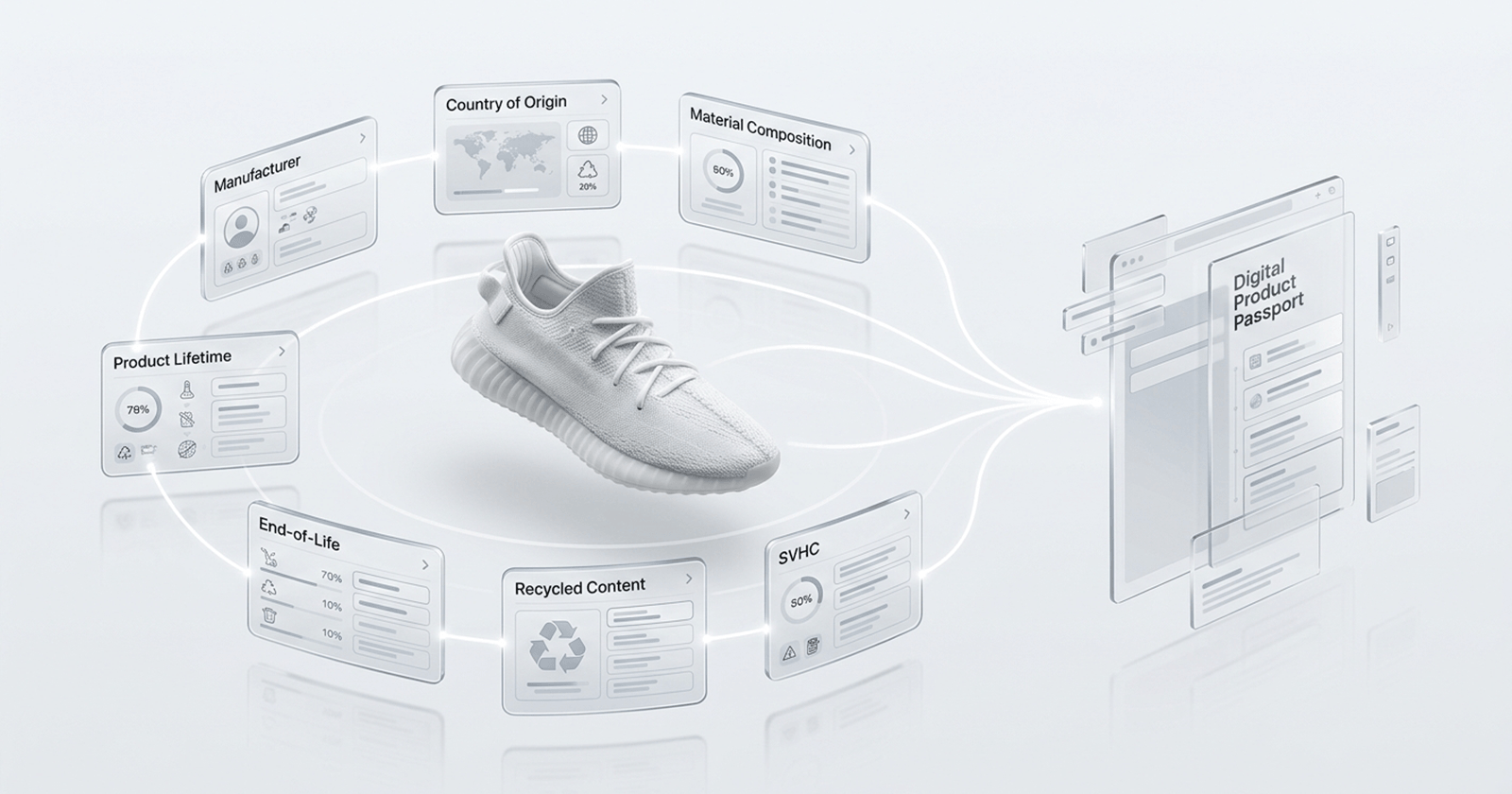
The EU Digital Product Passport FAQ is a document the European Commission published in December 2025 to explain, in one place, how the Digital Product Passport (DPP) works. A DPP is a digital identity card for a product: scan a code on the item or its packaging, and you can see what it is made of, how long it should last, whether it can be repaired, and how to recycle it at the end. The FAQ answers 32 questions and is meant as plain-language guidance, not new law. The Commission is clear about this: it calls the FAQ a "living document" and says it does not create any obligation that the regulation does not already contain.
Direct link to Digital Product Passport FAQ
So nothing changes because this FAQ exists. What changes is that, for the first time, there is one official place to point to when someone asks you what a DPP actually is.
For two years, anyone trying to understand the Digital Product Passport had to read the regulation itself and piece the picture together. The FAQ does that work for you. It walks through what a DPP is, who has to make one, when, and how the system works behind the scenes.
One thing to understand before anything else: this FAQ covers the general framework only. The Digital Product Passport reaches businesses through two different routes. Most product categories get a DPP through the Ecodesign for Sustainable Products Regulation (ESPR) – the broad law that the Commission fills in sector by sector. But some products get a DPP through their own dedicated law: batteries, toys, construction products each have separate rules. The FAQ explains the shared framework and deliberately leaves those sector laws aside.
That matters for a simple reason. If you sell batteries, your deadline does not live in this document – it lives in the Battery Regulation. For a full breakdown of the Battery Passport and its 18 February 2027 deadline, see our dedicated article.
Battery Passport and its 18 February 2027 deadline
The good news is that all of these passports, wherever the rules come from, run on the same underlying system. Learn the framework once and it applies everywhere.
This is the question that worries people, so here is the honest answer first: probably not today, and the FAQ is unusually clear about why.
The Commission works through a schedule called the ESPR Working Plan, which lists the product groups it intends to look at:
- 2026 – iron and steel
- 2027 – textiles, tyres, aluminium
- 2028 – furniture
- 2029 – mattresses and ICT products
Here is the part almost everyone gets wrong. Being on this list does not mean your product needs a passport. The FAQ states it plainly: a product group appearing in the Working Plan only means it has been scheduled for study. A separate piece of legislation – a "delegated act" – then decides whether a DPP is actually required and sets the real compliance date. Until that act is published for your category, there is no fixed deadline to miss.
So the calendar above is not a countdown. It is a list of which sectors the Commission is examining and roughly when. The work to do now is preparation, not panic. If you want the full step-by-step of how the timeline turns into obligations, we cover that in our EU Digital Product Passport guide for 2026–2030.
EU Digital Product Passport guide for 2026–2030
A few more things the FAQ settles cleanly. If you don't comply, penalties are set by each EU country, not by Brussels – and the law requires them to be "effective, proportionate and dissuasive." The FAQ does not name amounts, and neither should anyone else who hasn't read your national rules. Penalties can also reach online marketplaces, not just manufacturers.
If you import from outside the EU, a DPP is required for imported goods once a delegated act demands one – and a product without a registered passport can be stopped at the border before it is released for sale.
This is the fear behind every other question, and the FAQ answers it directly. You do not have to build any of this yourself. The regulation creates a role called a DPP service provider – an independent company that hosts and manages the passport on your behalf, including the backups the law requires.
It helps to see what such a provider actually does, because "they store your data" undersells it. The provider is the hub that connects you to the EU system and keeps several obligations running at once.
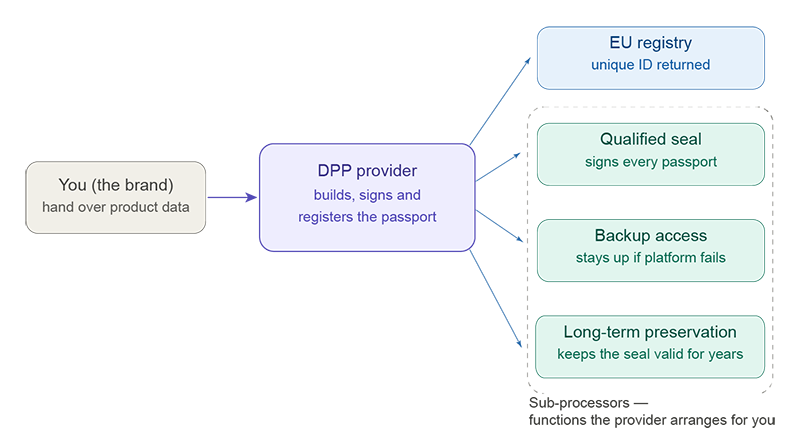
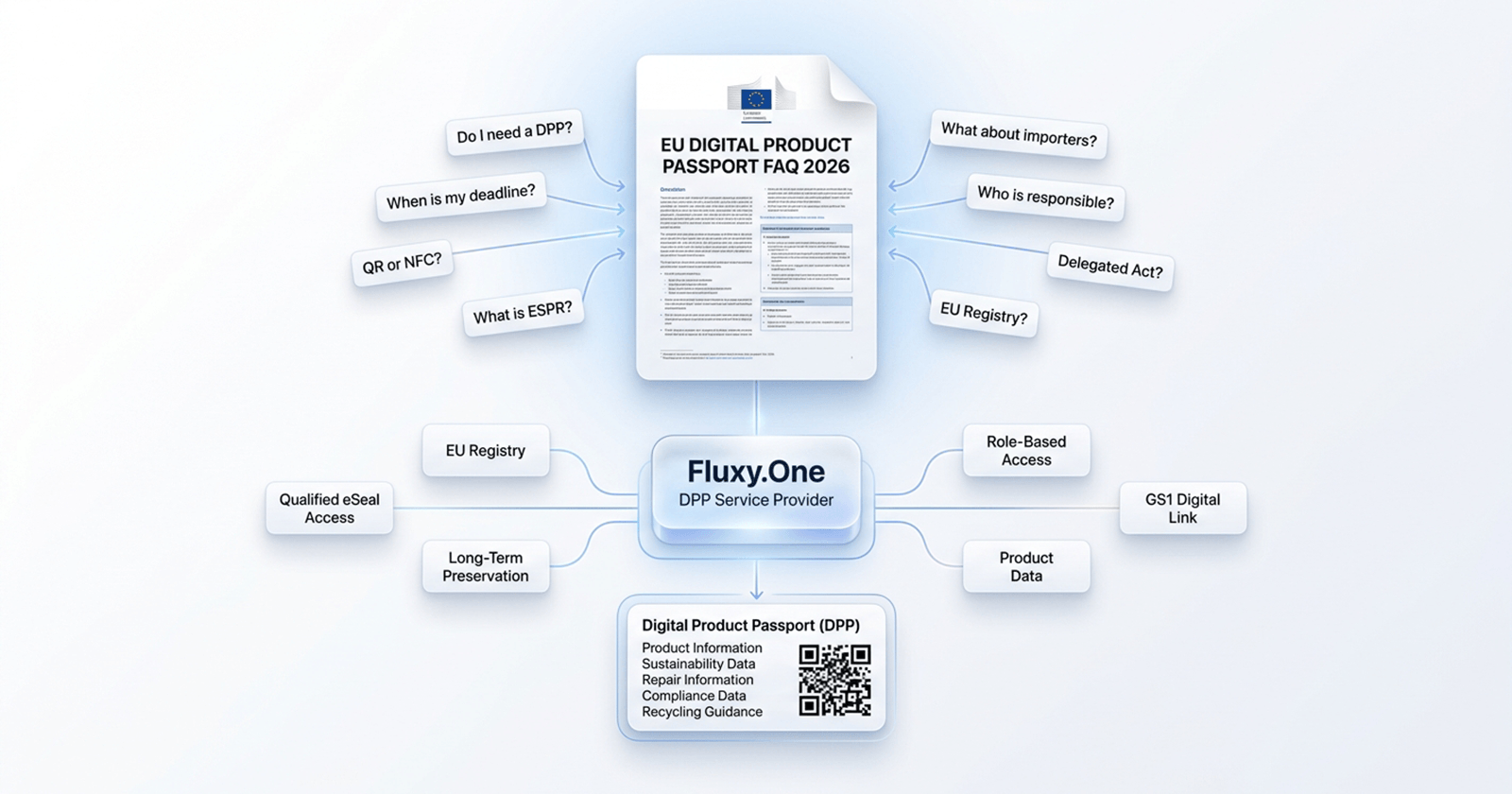
"DPP provider as a data hub" — the brand hands product data to the provider; the provider registers it in the EU registry and arranges three sub-processor functions: qualified seal, backup access, and long-term preservation; access to the passport is role-based (public / authorities / recyclers).
You hand over your product information once. From there the provider builds the passport in the format the Commission expects, registers it in the central EU registry, and arranges three things you would otherwise have to solve alone: a qualified electronic seal, so every passport carries a valid digital signature; backup access, so the passport stays reachable even if the provider's own platform goes down; and long-term preservation, which keeps that signature valid for years as the product lives on. Underneath it all, the same passport shows different information to different people – the public sees one layer, authorities and recyclers see more – based on who is asking.
One line matters more than the rest, and it is the same whether you run the passport yourself or through a provider: responsibility cannot be handed off. Even when a provider registers the passport for you, you – the business placing the product on the market – remain legally accountable for the data inside it. A provider does the work; it does not absorb the liability. For how to judge a provider and how delegated registration is set up, see the platform section of our DPP guide.
Fluxy.One is one such provider, built for exactly this: manufacturers, importers and independent brands who need the passport handled without building infrastructure of their own.
There is also real support for smaller companies written into the law. Under Article 22 of the ESPR, each EU country has to set up help for SMEs – information points, and in some cases training or financial assistance – and the Commission has committed to free digital tools as each new set of rules arrives. And before any DPP becomes mandatory for a category, there is a public consultation: small businesses get a say, often through their trade associations, before the deadline is fixed.
The FAQ clears up a common worry about a giant central database holding everything. It does not work that way. The EU registry stores only an identifier and a pointer – the unique code for your product and the location of its passport. The actual product data stays decentralised, held by you or your provider. The registry opens on 19 July 2026; the automatic connection to customs systems follows later, expected around 2029.
On privacy: the system is built around product information, not people. The FAQ confirms that personal customer data is not stored in a DPP by default, and that general access to product information is anonymous.
The FAQ also spells out what a shopper actually sees when they scan. Depending on what each category's rules require, that can include the materials inside the product, how durable it is, its environmental footprint, repair instructions, and guidance on recycling it. The exact fields are set category by category. The direction is consistent: enough to compare two products honestly, and to keep the item in use longer.
You do not need a passport this week. You do need to know where you stand. Four steps, none of which require waiting for a deadline:
If you'd like a straight answer about your own products and markets, Fluxy.One offers a free initial consultation – no commitment, just clarity.
You can read the full document on the European Commission's CIRCABC portal: Digital Product Passport – Frequently Asked Questions.
Fluxy.One — the transparency infrastructure for the global economy.
Book Free Demo



Privacy is important to us, so you have the option of disabling certain types of storage that may not be necessary for the basic functioning of the website. Blocking categories may impact your experience on the website. More information

Privacy is important to us, so you have the option of disabling certain types of storage that may not be necessary for the basic functioning of the website. Blocking categories may impact your experience on the website. More information