Articles
Your packaging says "eco-friendly". In September, that becomes illegal.
In June 2025, the EU's proposed Green Claims Directive was shelved. Many brands quietly celebrated. They shouldn't have.


In June 2025, the EU's proposed Green Claims Directive was shelved. Many brands quietly celebrated. They shouldn't have.
Last summer, the European Commission announced it was withdrawing its proposal for a Green Claims Directive – a sweeping regulation that would have required independent third-party verification for virtually every environmental claim a company makes. The news was met with relief across marketing departments from Amsterdam to Milan. One less compliance project. One less deadline.
Except the relief was based on a misreading of what had actually happened.
The Green Claims Directive was a proposal. What's already law – adopted by the European Parliament and Council on 28 February 2024, published in the Official Journal on 6 March 2024 – is Directive (EU) 2024/825, the Directive on Empowering Consumers for the Green Transition, known as ECGT. It was never in doubt. It was never paused. Member states had until 27 March 2026 to write it into national law. That deadline has passed. In most EU member states, these rules are already part of national consumer law. From 27 September 2026, enforcement begins – meaning that from that date, a national authority can act on a complaint, a court can uphold it, and a fine can follow.
That's less than five months away.
The ECGT works by amending two existing pieces of EU consumer law: the Unfair Commercial Practices Directive (2005/29/EC) and the Consumer Rights Directive (2011/83/EU). The first of these already contained a "blacklist" – commercial practices prohibited in all circumstances, regardless of context or intent. The ECGT adds new entries to that list.
Start with the one that will catch the most brands off guard: the word "biodegradable."
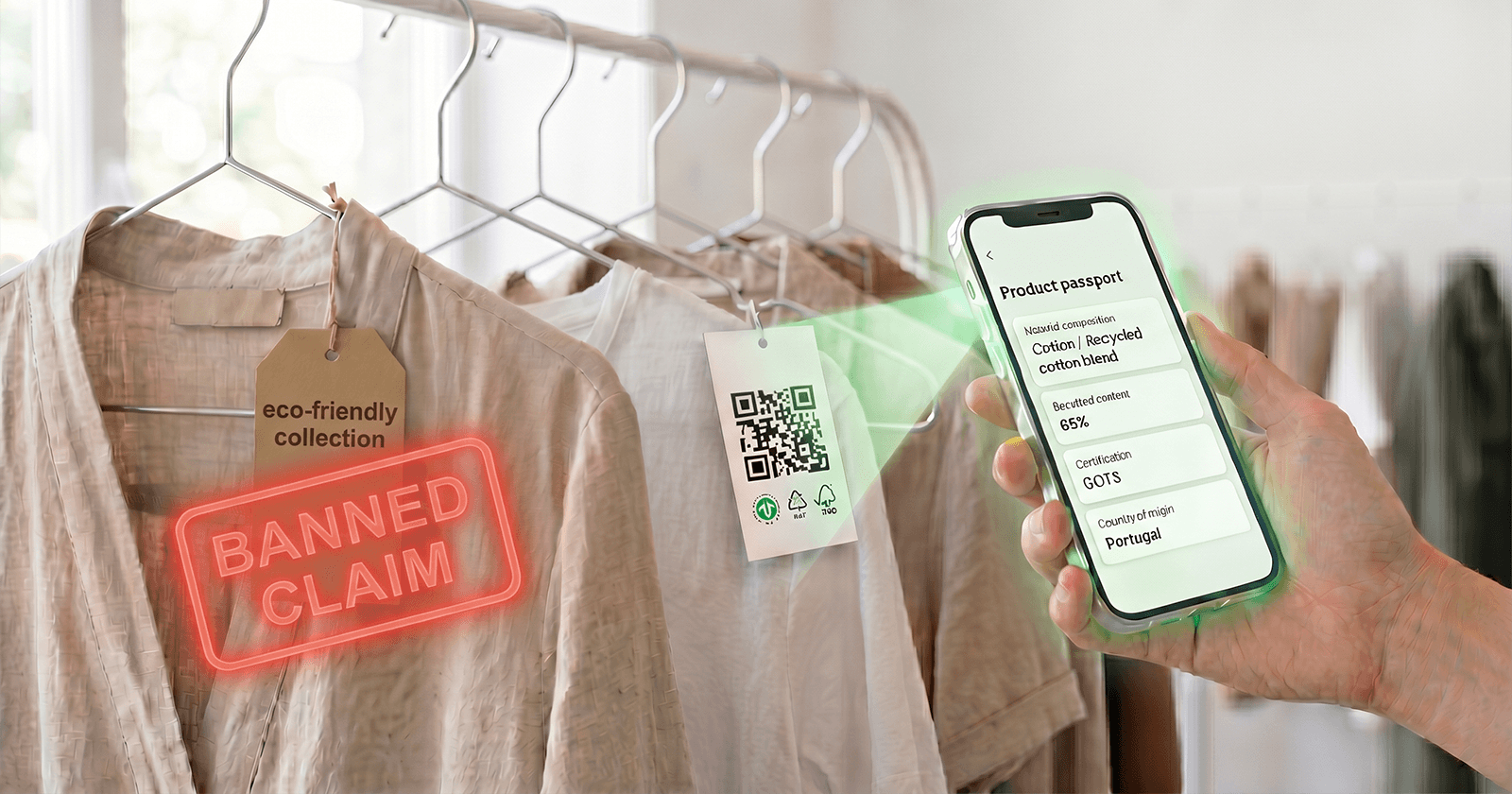
It sounds precise. It sounds scientific. It sounds like exactly the kind of claim you should be able to make if your product is made from plant fibres or compostable materials. But "biodegradable" is a claim about what happens to a product at the end of its life – under what conditions, over what timeframe, in what environment. A cotton shirt is technically biodegradable. So is a piece of leather. So, under the right conditions, is some plastic. The word on its own tells a consumer nothing verifiable and implies a lot that may be false. Under the amended Annex I of the Unfair Commercial Practices Directive, it joins the list of prohibited generic environmental claims – alongside "environmentally friendly", "eco-friendly", "green", "ecological", "climate-friendly", "carbon-friendly", "nature's friend", and similar.
The other new entries matter just as much. Making an environmental claim about an entire product or an entire business when the claim is only true of one aspect – saying a collection is "sustainable" because the packaging is recycled, for example – is prohibited. Displaying a sustainability label that isn't based on a certification scheme established by a public authority or meeting independently verified minimum standards is prohibited. Claiming a product has a neutral or positive environmental impact based on carbon offset schemes, rather than actual emissions reductions in the value chain, is prohibited. Presenting a legal requirement – something the regulation mandates for all products in a category – as a distinctive sustainability feature of your own product is prohibited.
Each of these is a blacklisted practice. That means no case-by-case assessment is needed for enforcement. The practice occurs, it's illegal.
The natural assumption is that these rules are aimed at fast fashion giants and household-name consumer goods companies. The Sheins and the Armanis. Brands with marketing budgets large enough to construct sustainability narratives on thin air.
That assumption is wrong on two counts.
First, enforcement doesn't sort by company size. National consumer protection authorities – and competitors – can file complaints against any trader operating in the EU market, regardless of revenue. The ECGT provides for fines up to 4% of annual turnover in the relevant member states. For a brand turning over €2 million in Germany, that's €80,000.
Second, the practices being banned are not exotic. They are the everyday language of small brand sustainability communication. Think of a woman who started a linen clothing line in 2021, sews in Portugal, sources certified fabric from a Belgian supplier, and genuinely cares about what she makes. Her hang tags say "eco collection." Her Instagram bio says "slow and sustainable fashion." Her website header has a small leaf icon she designed herself. None of this required a PR department. All of it may become legally problematic from September.
The ECGT draws no distinction between a coordinated corporate greenwashing campaign and a two-word label printed on a hang tag. What matters is whether the claim reaches a consumer and whether it implies environmental performance that cannot be demonstrated.
German courts have already been enforcing this logic under existing consumer law, before the ECGT even applies. In one case, a court banned a major airline from advertising a carbon-neutral booking option, ruling that the offsetting scheme behind the claim was insufficient to support it. The ECGT now puts this standard into EU-wide statute.
The directive is not a ban on talking about sustainability. It is a ban on talking about it without evidence.
The distinction matters, and it's concrete. A claim that a jacket is made from "65% recycled polyester, sourced from post-consumer plastic bottles" is specific, verifiable, and refers to a defined aspect of a defined product. A claim that the same jacket is "eco-friendly" implies a totality of environmental performance that the fabric content alone cannot support.
A GOTS or EU Ecolabel certification is based on a recognised scheme with independent third-party monitoring. It is compliant. A leaf icon designed in-house, or a badge reading "Brand X Certified Sustainable" with no independent oversight behind it, is a self-created sustainability label. It is not.
One further point for brands that have built communications around carbon offset programmes: the ECGT explicitly blacklists product-level claims of carbon neutrality or positive environmental impact that rest on offsetting rather than actual measured reductions in the value chain. "Carbon neutral" – if it rests on purchased credits rather than documented, reduced emissions – comes off the packaging.
Here is the deeper issue, and it doesn't appear in any summary of the directive.
The ECGT doesn't tell brands what data they need. It tells them they need data. The question of what evidence is sufficient to substantiate a specific environmental claim will be defined, over time, through enforcement practice and national case law. That uncertainty is uncomfortable, but it points toward an obvious practical conclusion: the safest environmental claims are the ones backed by structured, traceable, product-level data.
This is where most small brands have nothing.
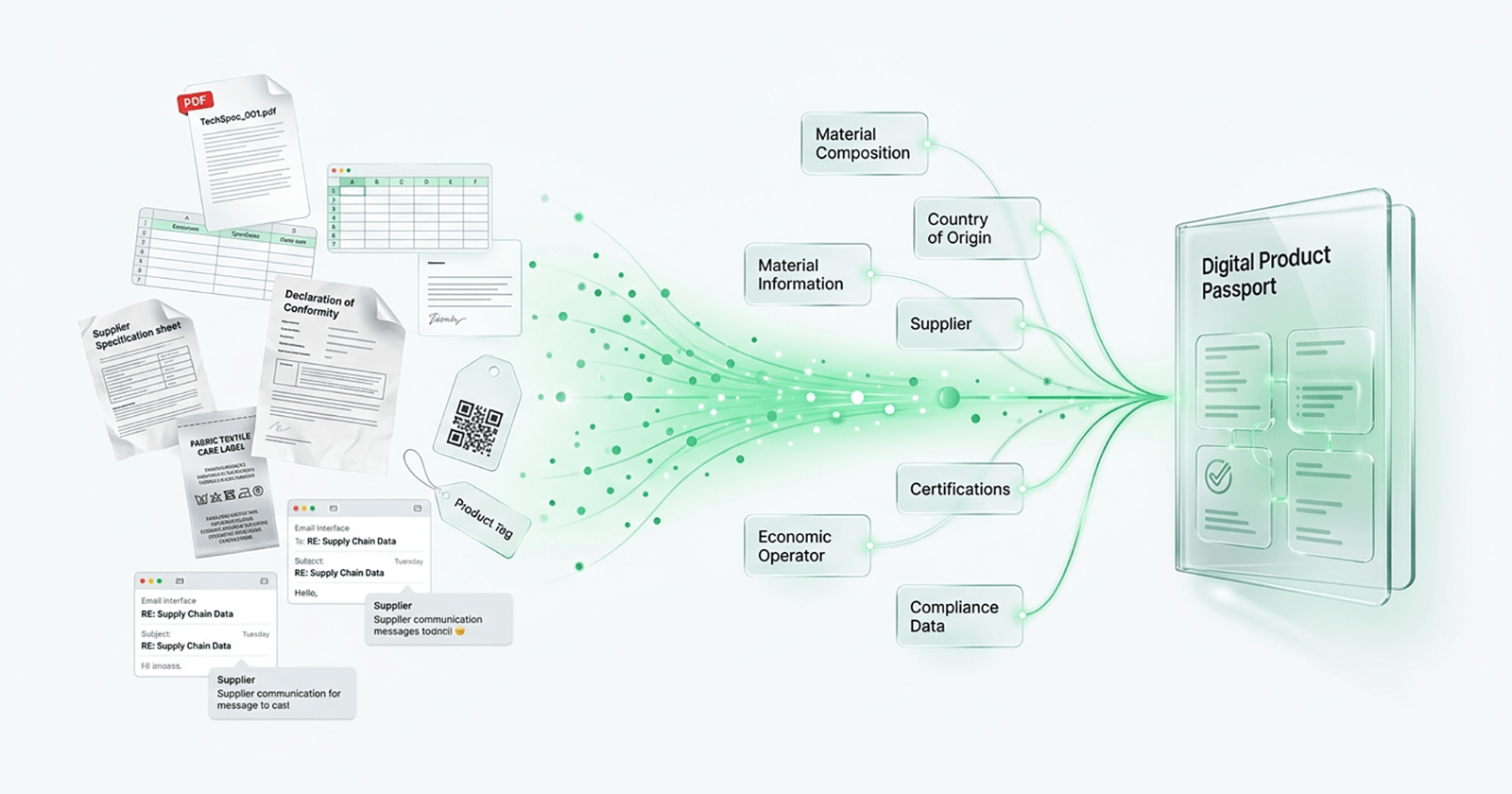
Not because they haven't been trying to do the right thing. But because "sustainable sourcing" has lived in email threads with suppliers, in verbal agreements, in someone's memory of a factory visit. Not in a structured record. Not in a format that travels with the product. Not in something an authority could examine.
The evidence that makes a green claim defensible is the same evidence that a Digital Product Passport will eventually need to contain – material composition, recycled content percentages, carbon footprint figures, supply chain origin. Brands that build that data layer now, before ESPR delegated acts make it mandatory, get two things at once: ECGT protection and DPP readiness.
Before 27 September 2026, go through your product packaging, hang tags, website copy, and social media descriptions. Pull every word or phrase that implies environmental benefit: "eco", "green", "sustainable", "natural", "clean", "conscious", "responsible", "planet-friendly", "biodegradable", "carbon neutral", "climate positive", and any equivalent in the languages of your EU markets.
For each one, ask a single question: what specific, verifiable evidence supports this claim about this specific product?
If the answer is a current certification from a recognised scheme – GOTS, OEKO-TEX, EU Ecolabel, Bluesign – keep the claim and make the certification visible.
If the answer is internal data – recycled content percentages, measured carbon figures, supplier declarations – make the claim specific. "Made with 40% recycled cotton" rather than "sustainable cotton collection."
If the answer is a carbon offset programme, the product-level neutrality claim comes off.
If there is no answer, the claim comes off.
This is not paperwork. National enforcement authorities are already running greenwashing investigations under the existing framework. Competitors can file complaints. Consumers can file complaints. The ECGT gives both of them a cleaner legal basis to do so starting this autumn.
If you have run through this audit and found that the data simply isn't there – that you know your product is good but can't prove it in writing – that's a data problem, not a values problem. {ZeroBox} is built for exactly this starting point: helping independent brands structure their product information in a format that's verifiable, exportable, and ready for whatever comes next on the regulatory calendar.
Fluxy.One — the transparency infrastructure for the global economy.
Book Free Demo



Privacy is important to us, so you have the option of disabling certain types of storage that may not be necessary for the basic functioning of the website. Blocking categories may impact your experience on the website. More information

Privacy is important to us, so you have the option of disabling certain types of storage that may not be necessary for the basic functioning of the website. Blocking categories may impact your experience on the website. More information