Imagine buying a second-hand electric car. The first question is always the battery. How degraded is it? How many charge cycles? Where was it made, and from what?
Today, there is no reliable way to answer any of that. The data exists somewhere — the manufacturer has it — but it rarely travels with the battery. Once a product leaves the factory, the trail goes cold.
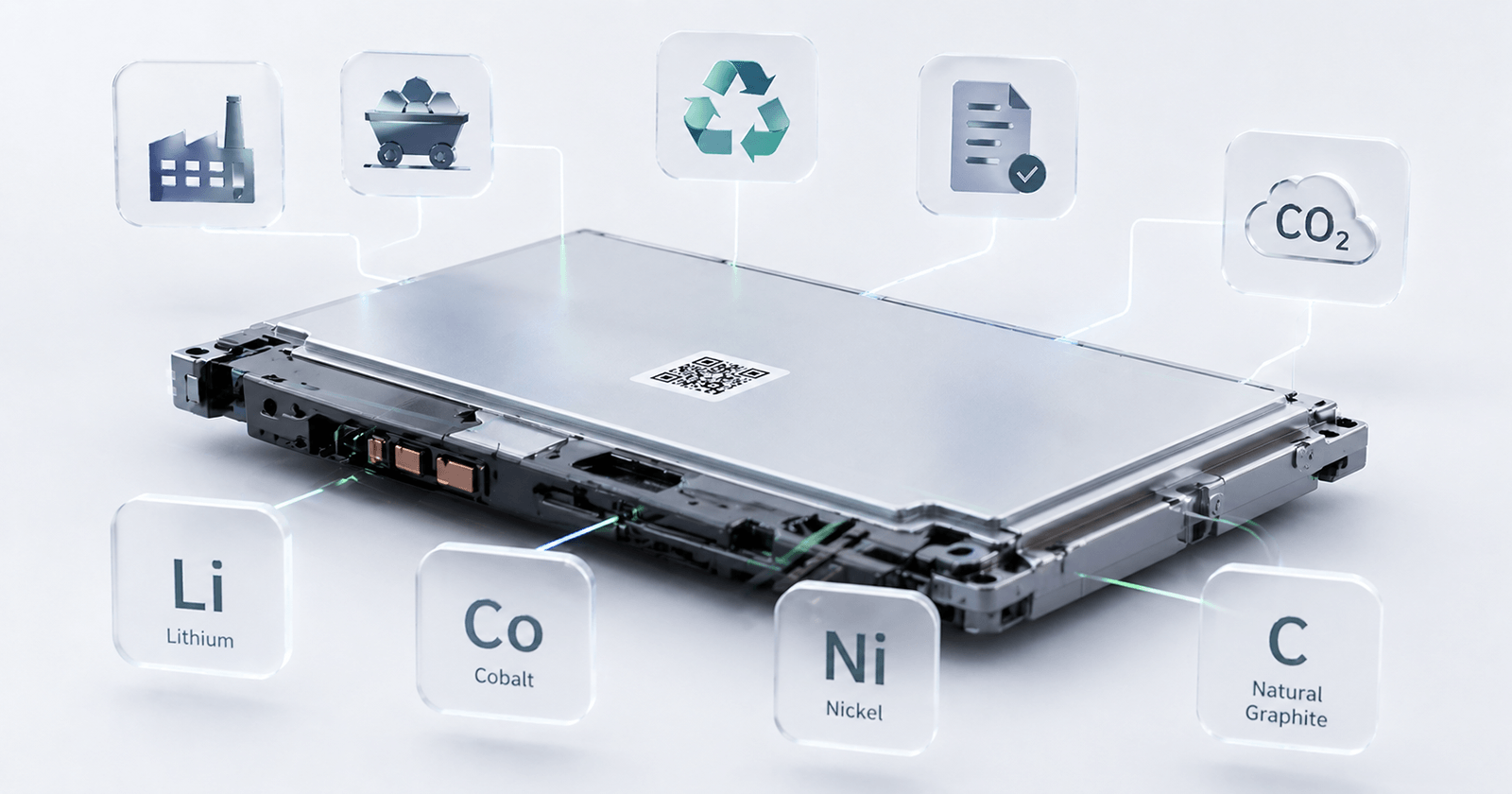
The EU Battery Passport exists to fix that. From 18 February 2027, certain batteries sold or put into use in the EU must carry a digital record — reachable by scanning a QR code on the battery itself — with verified information about what the battery contains, its carbon footprint, how it performs, and what should happen to it when it dies.
This is not a voluntary scheme. It is a legal requirement under Regulation (EU) 2023/1542, the EU's Battery Regulation, which came into force in August 2023 and replaced a directive that had been largely unchanged since 2006.
Which batteries need a passport
The regulation covers five battery categories in total, but the passport requirement applies to three of them. The fastest way to know whether your product is affected is to identify its category and check against the thresholds below.
Industrial batteries above 2 kWh. This covers batteries in forklifts, manufacturing equipment, industrial robots, automated warehouses, and commercial energy storage systems. The 2 kWh threshold is the deciding line. Below it: no passport. Above it: passport required. Most batteries used in serious industrial settings sit well above it.
The definition of "industrial battery" is broader than it sounds. A high-capacity portable power station or a commercial lawnmower running on a battery above 2 kWh both qualify as industrial batteries under the regulation. When in doubt, Article 3 of Regulation (EU) 2023/1542 is the place to check the exact definitions.
EV batteries. Every battery that powers a road vehicle — electric car, van, truck — needs a passport. There is no minimum size. All EV batteries are in scope.
LMT batteries. LMT stands for light means of transport: e-bikes, electric scooters, electric mopeds, hoverboards. No minimum size applies here either. All LMT batteries are in scope, with the same passport deadline as EVs and industrial: 18 February 2027.
What does not need a passport: laptop batteries, phone batteries, AA cells — anything classified as a portable battery, generally under 5 kg and not designed for industrial use or transport. SLI batteries, the starter batteries in petrol and diesel vehicles, are also out of scope for the passport. Both categories still carry labelling, safety, and recycling obligations under the same regulation, just not the passport.
The product question. The passport belongs to the battery, not the device containing it. But that does not let device manufacturers off the hook. If you sell e-bikes in the EU, you are placing LMT batteries on the EU market. The regulation covers batteries whether sold on their own or installed inside a product. Whoever places that battery on the EU market — or puts it into service — is responsible for ensuring the passport exists and stays accurate. Not the supplier. Not the factory abroad. You.
Two things that regularly catch companies by surprise. First: replacement batteries. A replacement battery sold separately is treated as a new market placement, and the passport obligation applies in full. Second: second-life batteries. If a battery that has completed its first use — say, an EV battery repurposed for warehouse energy storage — is placed on the market again, it is generally back in scope. Its passport must reflect that history.
Once you have confirmed your product is in scope, the next question is what the passport actually needs to contain.
What goes inside a Battery Passport
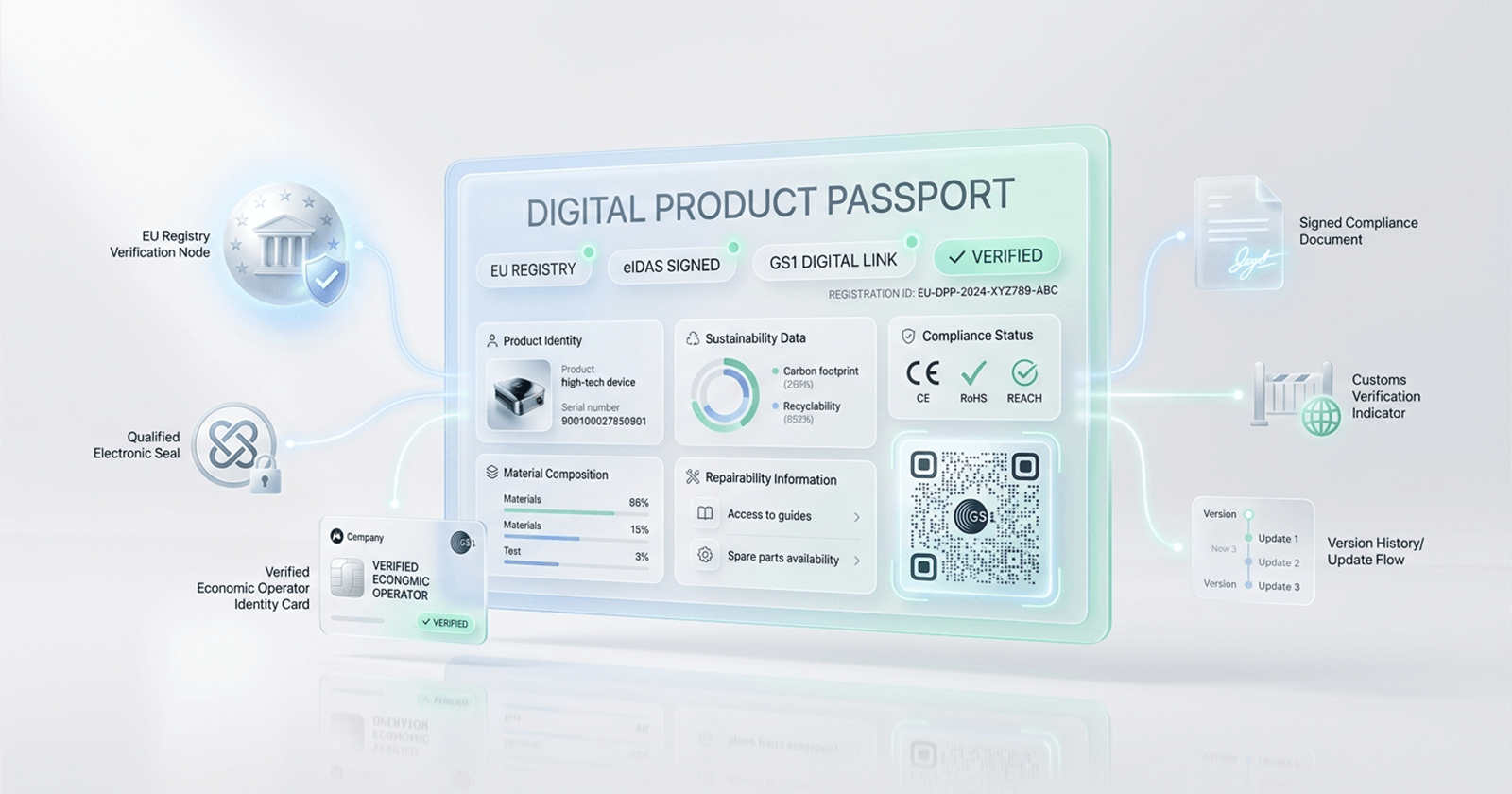
Scan the QR code on the battery and you reach a structured digital file. Not a brochure — a standardised dataset defined in Article 77 and Annex XIII of Regulation (EU) 2023/1542.
One thing the regulation gets right: not everything is public. The passport is built in three access tiers.
Anyone can see: basic battery identity, the carbon footprint figure, a summary of chemical composition, performance indicators, recycled content data, and end-of-life guidance. This is what a consumer, a journalist, or a regulator sees when they scan the QR code.
Parties with a legitimate interest can see more: detailed material composition down to cathode, anode, and electrolyte level; full disassembly instructions with diagrams, required tools, and safety warnings; and — for individual battery units — state of health, charge cycle history, temperature records, and status across the battery's life. This layer exists for recyclers, repair technicians, and second-life operators: the people who need the real detail to do their jobs.
Only authorities see: technical compliance reports, evidence packages, and the data behind the declared figures. Notified bodies, market surveillance authorities, and the European Commission.
Commercially sensitive information — proprietary formulations, intellectual property, competitive data — is explicitly protected under Annex XIII. One of the most common objections from manufacturers is "we cannot share our composition." Under the regulation, they do not share everything with everyone. The tiered structure exists precisely to balance transparency with legitimate business interests.
Here is what the passport must contain:
Battery identity. Model and version, unique unit identifier linked to the QR code, category and chemistry, manufacturer name and location, production date. Each passport ties to one specific physical battery, not just a product family.
Carbon footprint. A calculated number — not an estimate — covering emissions from raw material extraction through manufacturing. Calculated per production site and per batch. Carbon offsets cannot be used to reduce the figure.
Material composition and raw material origins. Chemical composition including the critical raw materials — cobalt, lithium, nickel, natural graphite — with sourcing information. Hazardous substances must be disclosed. Detailed composition data is accessible only to parties with legitimate interest.
Performance and durability. Rated capacity, voltage range, power capability, expected lifetime in cycles and the test method used. Warranty period. Technical documentation on how the performance data was obtained.
Dismantling and safety information. Step-by-step disassembly instructions, required tools, safety warnings. Accessible to repair technicians and recyclers, not the general public.
Recycling and end-of-life data. Recycled content percentages, collection guidance, information for recyclers and second-life operators.
Lifecycle updates. This is what surprises most people. The passport is not a one-time document — it is a living record. For each individual battery unit, it must be updated throughout the battery's life: state of health, charge cycles, temperature history, notable events, and status — original use, re-used, repurposed, remanufactured, or approaching end of life. This data is not public, but it must exist and be maintained.
The 2027 passport covers the foundations. The regulation explicitly anticipates that delegated acts will expand required data fields over time.
With the scope and content clear, here is how the obligations actually roll out.
The full timeline
The Battery Regulation is not one deadline — it is a chain of them running from 2023 to 2030. Several have already passed. The ones that matter most for companies preparing now:
18 February 2025 — Carbon footprint declaration, EV batteries. Already in effect. EV battery manufacturers must provide a carbon footprint declaration per battery model, per production site.
18 February 2026 — Carbon footprint declaration, industrial batteries above 2 kWh. Less than a year away. For each industrial battery model, a carbon footprint declaration is required per production site. Until the digital passport goes live in 2027, this declaration accompanies the battery physically.
18 February 2027 — Battery Passport mandatory. Industrial batteries above 2 kWh, EV batteries, and LMT batteries must each carry a digital passport accessible via QR code. A battery without a passport cannot legally be placed on the EU market or put into service from this date. This obligation is set out in Article 77 of Regulation (EU) 2023/1542.
18 August 2027 — Due diligence obligations. Companies must have policies in place to identify and manage supply chain risks for critical raw materials: cobalt, lithium, nickel, natural graphite. Originally due August 2025, the deadline was pushed to August 2027 by Regulation (EU) 2025/1561. The current exemption threshold under Article 47 of the original regulation is a net annual turnover below €40 million. The European Commission proposed raising this to €150 million as part of the Omnibus IV package — but at the time of publication, that change had not yet been adopted into law.
18 August 2028 — Carbon footprint declaration, LMT batteries. The passport for e-bikes and scooters is required from 2027. The carbon footprint declaration for LMT has a separate, later deadline: August 2028.
18 August 2028 — Minimum recycled content. Industrial batteries above 2 kWh, EV batteries, and LMT batteries must contain minimum percentages of recycled cobalt, lithium, nickel, and lead in the finished product.
18 August 2030 — Carbon footprint declaration, stationary energy storage systems (SBESS). SBESS — batteries designed specifically to store and deliver energy to and from the grid — are a subcategory of industrial batteries. Their battery passport falls under the industrial battery deadline of 2027. The 2030 date applies specifically to their carbon footprint declaration, which carries a longer timeline given the complexity of lifecycle calculations for grid-scale systems.
One important note: some obligations under the regulation are conditioned on delegated and implementing acts being published by the European Commission. Where acts have not yet been finalised, certain requirements apply 18 months after the relevant act enters into force. Companies should track the Commission's publication schedule directly, not just the headline dates.
The timeline tells you when. The next section tells you who exactly is on the hook.
Who is responsible
The regulation assigns responsibility to "economic operators." In practice: manufacturers, importers, distributors, and authorised representatives. The definitions are set out in Article 3 of Regulation (EU) 2023/1542.
If you manufacture batteries or products containing in-scope batteries and sell them in the EU — you are responsible.
If you import batteries or products from outside the EU — the obligation stays with you. The supplier's compliance with their own domestic rules does not satisfy your EU obligations.
If you are a non-EU company selling directly into the EU without a local entity — you will likely need to designate an authorised EU representative who can carry legal responsibility on your behalf.
If you are a distributor moving products between markets, your obligations are narrower — but you cannot knowingly sell non-compliant batteries, and you must be able to pass compliance information requests back through the chain.
One thing all economic operators share: the passport must stay accurate and up to date across the battery's entire life. For unit-level data — state of health, cycle history, status changes — this means ongoing maintenance, not a one-time submission.
Knowing who is responsible is step one. Knowing what "ready" actually requires is step two.
What being ready actually looks like
The QR code on the battery is the visible result. Getting there takes considerably more work.
The data a passport requires — carbon footprint per production site and batch, raw material origins at mine and refinery level, recycled content percentages, use-phase telemetry — does not currently exist in most companies' systems at the precision the regulation demands. It has to be built: collected, calculated, and validated across supply chains that can run through five or six countries.
Supply chain mapping. Where was your lithium mined? Where was your cobalt refined? What percentage of your nickel is recycled content? For most importers, answering these questions requires going several tiers deeper into the supply chain than current procurement practices reach.
Carbon footprint calculation. This covers the full production lifecycle — from raw material extraction to finished battery. It must be done per manufacturing site, per batch. A general sustainability report does not satisfy it. For carbon footprint and recycled content data, third-party verification through a Notified Body will be required.
Digital infrastructure for two levels of data. The passport operates at two levels simultaneously: model-level data (chemistry, design, carbon footprint, performance parameters) and unit-level data (individual serial identity, state of health, charge history, lifecycle status). Both must be maintained, at different cadences, in a system that controls access by stakeholder type and stays audit-ready across the battery's operational life.
This is where having the right platform makes the difference between manageable and chaotic. Fluxy.One's Battery Passport module handles both model and unit data, QR generation tied to unique identifiers, and the layered access structure the regulation requires — so the focus stays on getting the data right, not on building infrastructure from scratch.
The 2027 deadline is nine months away. Building passport-ready systems typically takes 12 to 18 months for companies starting from limited data maturity. For many, the comfortable window has already closed.
What happens if you are not ready
EU member states are required under Article 91 of Regulation (EU) 2023/1542 to set penalties that are effective, proportionate, and dissuasive. The specific amounts are set nationally — there is no single EU-wide fine. What the regulation sets at EU level is the market access rule: from 18 February 2027, a battery without a passport cannot legally be placed on the EU market or put into service. That means products stopped at the border, withdrawal from sale, and the disruption that follows.
The QR code is, among other things, an enforcement tool. One scan tells a market surveillance authority whether a passport exists, whether it is complete, and whether the data is current.
[H2] Where to start: a checklist
1. Classify your products. Does your battery — or the battery inside your product — fall into one of the three passport categories: industrial above 2 kWh, EV, or LMT? For EV and LMT, all batteries are in scope regardless of size. For industrial, check the 2 kWh threshold and the Article 3 definitions.
2. Identify your role. Manufacturer, importer, distributor, or authorised representative? Non-EU entities selling into the EU should check whether they need a local authorised representative.
3. Include replacement and second-life batteries. Replacement batteries are treated as new market placements. Repurposed batteries going back on the market are generally in scope. Make sure these are in your compliance planning.
4. Map your supply chain now. Start with critical raw materials: cobalt, lithium, nickel, natural graphite. This feeds both the passport and the due diligence obligation coming in August 2027.
5. Start the carbon footprint calculation. For industrial batteries, the declaration is due February 2026 — not 2027. If you have not started, this is already urgent.
6. Plan for Notified Body verification. Carbon footprint and recycled content data require third-party verification. Track the European Commission's battery implementation page for updates on the appointment of Notified Bodies — some deadlines are conditioned on that list being published.
7. Choose your digital infrastructure. You need a system that handles model-level and unit-level data separately, controls access by stakeholder tier, connects to supply chain inputs, and supports ongoing lifecycle updates. This is not a spreadsheet problem.
8. Assign ownership. Passport compliance cuts across procurement, sustainability, product, legal, and IT. Assign a programme owner with the authority to drive it across teams.
The Battery Regulation is the first EU framework to mandate a digital product passport at scale — ahead of the broader ESPR rollout covering textiles, electronics, and other product categories. Companies that build the right systems now will not just be compliant in 2027. They will have the foundation that the next decade of European product regulation is going to require anyway.
Fluxy.One supports Battery Passport implementation for manufacturers and importers working toward the 2027 deadline. Free consultation →