Articles
PPWR & EPR Compliance 2026: What EU Packaging Rules Mean for You
The EU PPWR is in force and EPR obligations are rising. See who's affected, the key packaging requirements, and the steps to get compliant in time.


The EU PPWR is in force and EPR obligations are rising. See who's affected, the key packaging requirements, and the steps to get compliant in time.
Imagine the rules of the road changing simultaneously across 27 countries. Not gradually, not differently in each one — but all at once, uniformly, everywhere. That is roughly what happened to European packaging law in February 2025.
On 11 February 2025, Regulation (EU) 2025/40 — the Packaging and Packaging Waste Regulation, or PPWR — entered into force. This is not an update to the previous rules. It is their complete replacement. The old Directive 94/62/EC, which had governed packaging across the EU since 1994, is being retired. In its place comes a directly applicable regulation — a legal instrument that, unlike a directive, does not need to be transposed into national law by each member state. It applies directly. Uniformly. Everywhere.
From February 2025, a transition period began. On 12 August 2026, that period ends — and the majority of the regulation's requirements become fully enforceable. Until then, businesses have time to understand what needs to be done. That time is shorter than it feels.
The first question most business owners ask when they hear about PPWR is: "Does this actually apply to me?" The answer is almost always yes.
The regulation covers everyone in the packaging chain on the European market: manufacturers, importers, distributors, retailers and online shops. And not only European companies. If you are based outside the EU but sell packaged goods to buyers in Europe — the regulation applies to you as well.
Size is not grounds for exemption. The only category that receives some relief on documentation requirements is micro-enterprises — companies with fewer than ten employees and annual turnover or balance sheet total not exceeding two million euros. But even they are not exempt from EPR registration. More on that below.
From 12 August 2026, every type of packaging placed on the EU market must be backed by an EU Declaration of Conformity — a document confirming that the packaging meets PPWR requirements.
The specifics depend on where you sit in the supply chain.
If you source packaging from a European manufacturer, the obligation to produce the Declaration of Conformity belongs to that manufacturer, not to you. Your task is simpler: request the document from your supplier and keep it on file. This applies to micro-businesses as well — even if your supplier handles the paperwork, you are required to hold it.
If you manufacture packaging yourself or source it from outside the EU, the responsibility for the declaration is yours.
One practical note: do not leave this request until the last moment. Suppliers dealing with dozens of clients simultaneously will be overwhelmed with these requests as August 2026 approaches.
From August 2026, packaging in contact with food may not contain PFAS — per- and polyfluoroalkyl substances, sometimes called "forever chemicals" — above specified thresholds. This primarily affects paper and cardboard packaging with moisture-resistant coatings: coffee cups, pizza boxes, takeaway bags.
If your business involves food packaging, ask your supplier for PFAS test results now. Finding an alternative supplier and switching packaging takes time.
From August 2026, any food service establishment offering takeaway food or drinks must accept a customer's own container — without additional charge and without any reduction in service quality. A modest requirement in scope, but telling in spirit: PPWR consistently pushes reuse logic at every level of the chain.
This is the most important point — and the one that causes the most confusion.
EPR — Extended Producer Responsibility — is the principle by which whoever places packaging on the market bears financial responsibility for what happens to that packaging after use. If you sold a product in packaging, you contribute to the cost of collecting and recycling it.
The rule that most often catches small businesses off guard: you must register in the EPR system of every EU country where you sell goods. Not just your primary market. Every one.
Selling into Germany — register in LUCID. France — CITEO. Spain — ECOEMBES. Italy — CONAI. And so on, for each country. This applies to companies of all sizes, without exception.
How that registration works depends on your situation — and this is where it is worth being precise, because the two scenarios are quite different.
If you have a legal entity in the EU, you register in national EPR registries directly, under your own name. No intermediary required.
If you have no legal entity in the EU and sell directly to European consumers — through your own website or a marketplace — you need an Authorised Representative: a person or company with a legal address in the EU who takes on responsibility for your EPR registration and reporting. Their contact details must appear on your packaging.
One important note for importers already active in the EU market: if you are selling physical products here, you very likely already have an Authorised Representative appointed under the General Product Safety Regulation (GPSR) — you cannot legally sell in the EU without one. That same representative can typically cover your PPWR obligations as well. If you are new to the EU market, this is the first thing to arrange.
August 2026 is not a finish line. It is the beginning of a new phase. PPWR is built as a multi-year process in which requirements become progressively more specific and more demanding.
Over the years that follow, the European Commission will publish implementing acts: concrete methodologies for calculating recyclability, standards for digital labelling, requirements for recycled plastic content. The 2030 horizon is already taking shape clearly enough: only packaging with sufficient recyclability will be permitted on the market; plastic packaging will need to contain a minimum percentage of recycled material; online shops will be required to offer reusable packaging as an option at checkout.
Companies that build a solid system for managing packaging data now will have a meaningful advantage. Information about material composition, layer weights and volumes placed on the market will be needed for digital labelling, for EPR reporting and for recyclability assessment — all at once. Collecting that data once and using it across multiple purposes is far more efficient than reconstructing it from scratch each time a new requirement lands.
Once a year, you log into the portal of a national registry — LUCID for Germany, for instance — and file your annual declaration. The system asks you to report how many kilograms of PET plastic you placed on the market, how much cardboard, how much glass, how much aluminium. One line per material type.
It sounds straightforward. In practice, it means taking every product you sold that year, working out how much packaging of which materials it contained, adding it all up by type, and arriving at a clean set of figures. If you have dozens of SKUs with different packaging from different suppliers, that calculation can easily consume several working days. Then the same exercise repeats for each additional country.
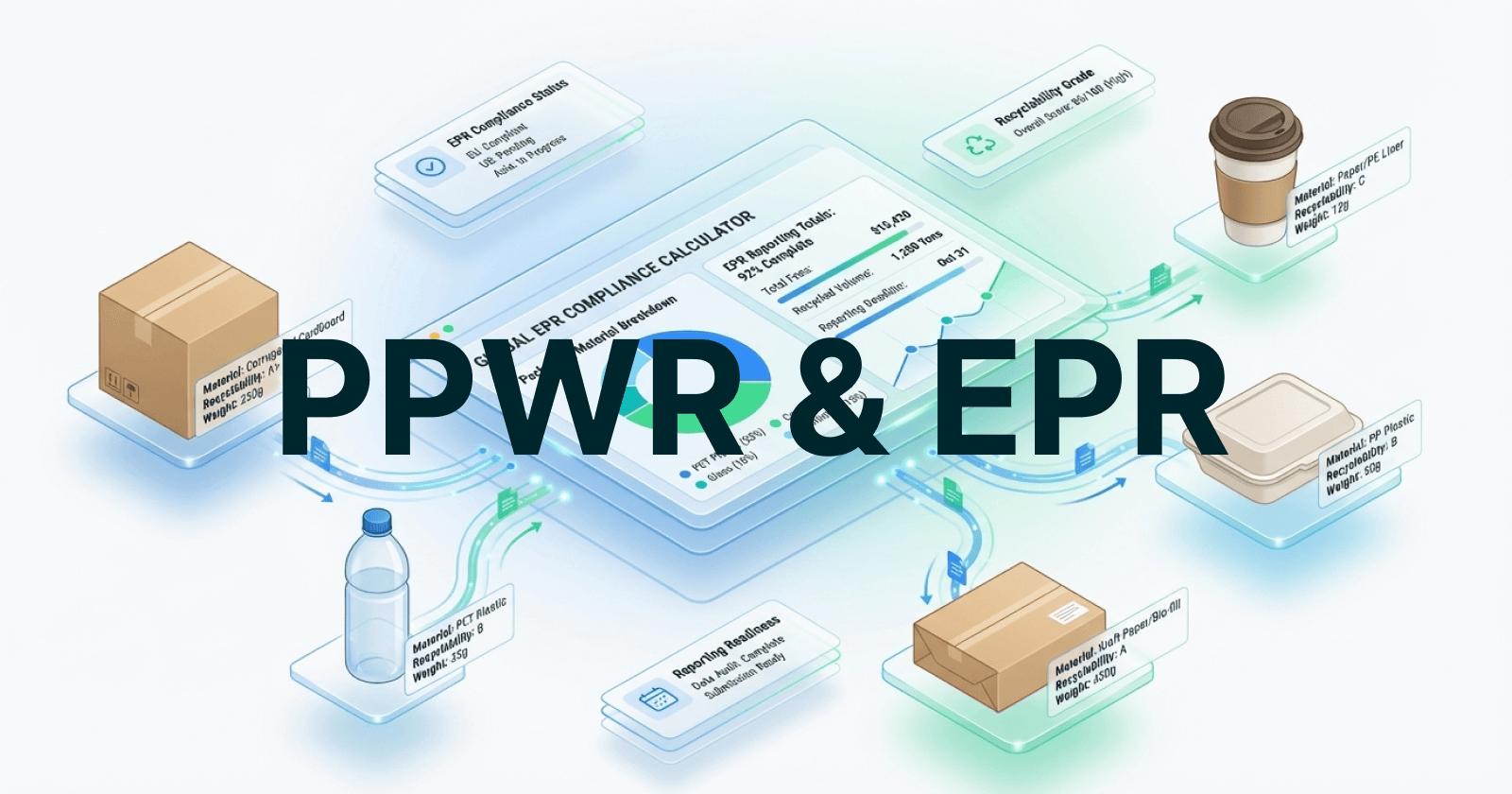
This is exactly the problem that {ZeroBox} is built to eliminate. You enter your packaging data once — every layer, every material, every weight. The system aggregates it and produces a report with total figures by material type: "Total PET plastic — 150.5 kg", "Total cardboard — 400.2 kg". When LUCID asks you to declare your paper volumes, you copy the number across. No parallel calculations, no room for error.
For companies selling across multiple European markets, {ZeroBox} includes a built-in registry guide — direct links to the registration portals of Germany, France, Spain, Italy and other EU countries, with guidance on what each one requires. Packaging data is entered once; the figures for any country's declaration are drawn from that same single source.
Most small brands don't fail at PPWR because the regulation is incomprehensible. They fail because compliance turns out to be an operational problem — data scattered across suppliers, figures calculated on instinct, declarations filed and quietly hoped for the best. Then an audit arrives.
{ZeroBox} is built around five answers to that reality.
No more guessing. Your EPR figures are calculated from verified packaging data, not estimates — so what you declare to a regulator matches exactly what you publish to a consumer. A discrepancy at audit becomes structurally impossible.
Weeks of work, compressed to minutes. Once your packaging profile is set up, your annual EPR declaration figures for any EU country are ready to copy across. No manual aggregation, no spreadsheet archaeology.
One source of truth. The data behind your product QR code and the data in your EPR report come from the same place. Always.
A guided path through the registries. Built-in directory of EU registration portals — Germany, France, Spain, Italy and beyond — with plain-language guidance on what each one requires.
A clearer picture of your packaging tax exposure. Your {ZeroBox} dashboard shows a TAX health breakdown: what share of your packaging falls under the standard EPR contribution rate — and what share attracts an elevated rate due to material type or recyclability. So you know not just what you owe, but where it makes financial sense to change your packaging first.
Step 1. Map your packaging. List every type of packaging you use — primary, secondary and transport. For each type: material and weight.
Step 2. Sort out your Declaration of Conformity. If you source packaging from a European manufacturer, request the document from them. If you manufacture it yourself or source it outside the EU, clarify who is responsible for the declaration in your case.
Step 3. Check food packaging for PFAS. If your products come into contact with food, ask your supplier for PFAS test results. Do this now, not in July 2026.
Step 4. Register in EPR registries. Identify every EU country you sell into. Each requires separate registration. If you have an EU legal entity, register directly. If not — and if you don't already have one from GPSR — appoint an Authorised Representative first.
Step 5. Build a system for packaging data. A spreadsheet works up to a point — perhaps one or two products, one country. Beyond that, you need a system where data is held in a structured way, updated centrally, and can be exported in formats suitable for EPR reporting and digital labelling. {ZeroBox} is designed precisely for this: a single place where your packaging profile, your product QR codes and your EPR reporting figures all live together.
August 2026 will arrive quickly. For most businesses, this does not have to be a crisis — provided the preparation starts now. The regulation is complex, but it is coherent. The important thing to understand is that this is not a one-time compliance event. It is a new operating standard for packaging, one that will keep evolving. Companies that build proper data infrastructure today will find themselves in a much stronger position in the years ahead — with regulators, with supply chain partners, and with the platforms and retailers that are already beginning to ask for this information.
{ZeroBox} is more than an EPR calculator or a PPWR compliance tool. It is a smart L2-level Digital Product Passport that ties all your technical and environmental data to the physical product through a GS1 Digital Link QR code — automatically translated into 24 European languages. When you build a product profile in {ZeroBox} , you are not just filing a declaration. You are creating a single source of truth that connects your packaging data, your consumer-facing QR code and your EPR reporting in one place. As new traceability laws arrive — including the mandatory Digital Product Passport under ESPR — you will not need to reprint packaging or rebuild systems from scratch. The architecture is already there. You update the data in the cloud; your customers, recycling partners and regulators instantly see a transparent, legally sound picture of your product from their phone. Whatever regulation comes next, you are ready for it.
Fluxy.One — the transparency infrastructure for the global economy.
Book Free Demo



Privacy is important to us, so you have the option of disabling certain types of storage that may not be necessary for the basic functioning of the website. Blocking categories may impact your experience on the website. More information

Privacy is important to us, so you have the option of disabling certain types of storage that may not be necessary for the basic functioning of the website. Blocking categories may impact your experience on the website. More information