Articles
EU Packaging EPR Fees 2026: Who Pays, Where, How Much
Who pays EU packaging EPR fees from 12 August 2026, in which country, for which packaging layers, and what makes the bill higher or lower. Plain answers.


Who pays EU packaging EPR fees from 12 August 2026, in which country, for which packaging layers, and what makes the bill higher or lower. Plain answers.
You sell a packaged product into the EU, so you owe a packaging fee. That part is simple. Who exactly owes it, in which country, for which packaging, and what sets the amount – none of that is, and most of the costly mistakes hide in those gaps. Here are the plain answers.
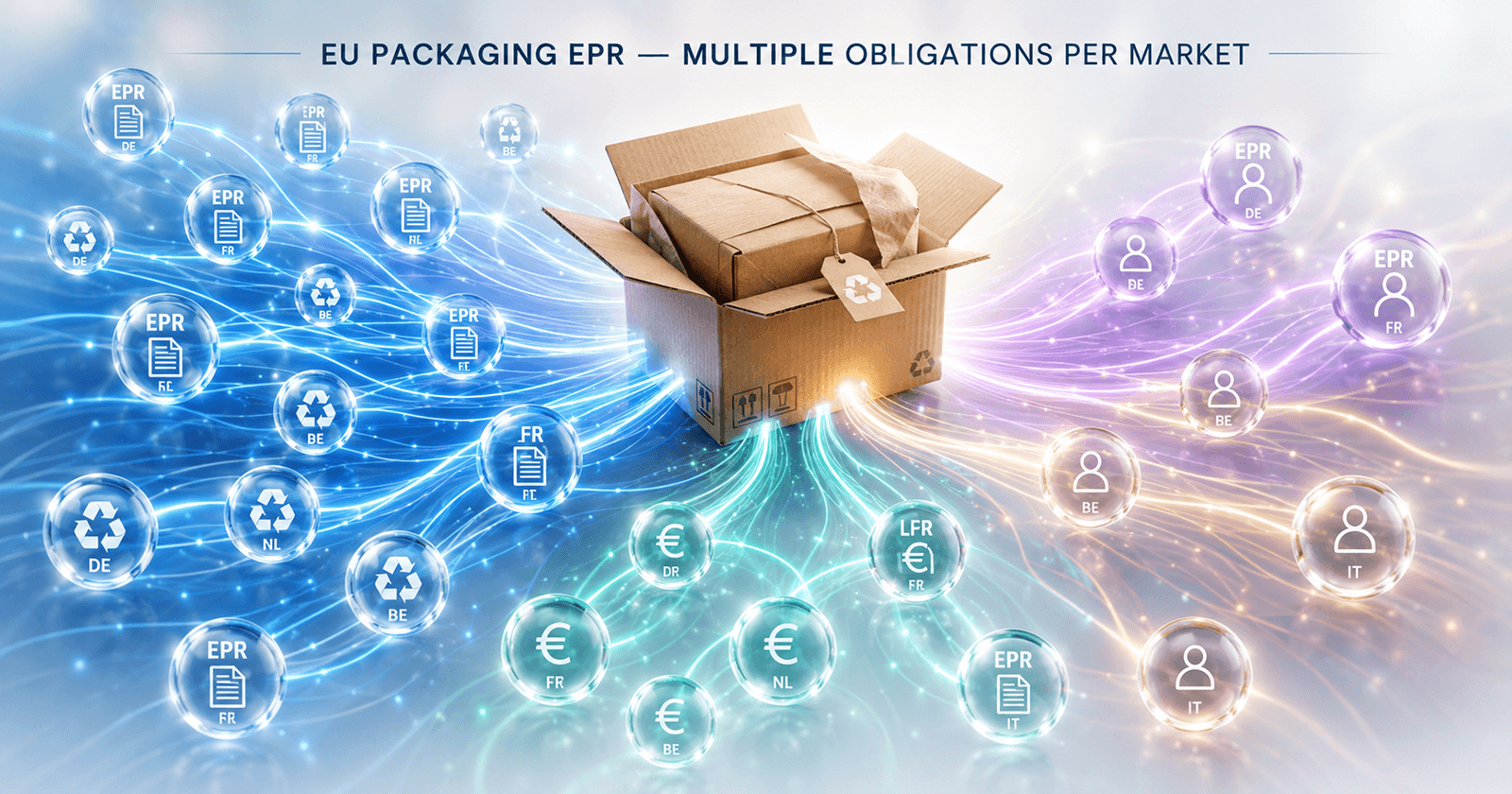
It isn't one, and it isn't only Latvian. From 12 August 2026, the EU applies a single rule for deciding who owes packaging fees and where – and for this brand, the answer lands in several countries, in a different name each time. The fee itself is old. The clarity about who pays it is new, and it catches people who were sure they were covered.
Taken in the order you'd actually ask the questions:
Extended Producer Responsibility – EPR, the principle that whoever puts packaging on the market helps fund collecting and recycling it – has run in Europe for years. The Packaging and Packaging Waste Regulation (PPWR, Regulation (EU) 2025/40) doesn't invent the fee. It standardises who pays.
It reaches everyone in the chain placing packaging on the EU market: manufacturers, importers, distributors, retailers, online sellers. Size is not an exit. As you'll see, the smallest companies get some relief on paperwork – but not on the fee itself. If your packaging reaches an EU consumer, you are in scope.
The regulation gives the payer a name: the producer. Not the factory that made the box – the company that first makes the packaging available in a given country. The guidance the European Commission published on 30 March 2026 is blunt about the consequence: roles are assigned per packaging and per member state, so the same company can be the producer in one country and not in another.
Who that turns out to be depends on what you do, not what you call yourself. A few worked examples, drawn from how the guidance and national schemes read it:
A brand that buys empty packaging and fills it with its own product – a cosmetics company, a food producer – is the producer for that packaged product. An importer who brings already-packed goods into a country is the producer there. A distributor who is first to put packaged goods on a national market is the producer in that market. And a trap worth naming: under Article 21 of the PPWR, an importer or distributor who sells packaging under their own name or trademark takes on the manufacturer's obligations too – branding it makes it yours.
So for the Latvian bag brand: at home and in the countries where it ships direct to consumers, it is the producer. For the batch wholesaled to the Belgian shop, the shop is first to place those goods on the Belgian market – the shop is the producer there.
A non-EU brand doesn't register itself. It appoints an authorised representative – a person or company established in the EU who registers, reports and pays the EPR fee on its behalf. And it's not one representative for the whole bloc. Article 45(3) of the PPWR is specific: a producer "shall appoint, by written mandate, an authorised representative for the extended producer responsibility in each Member State where the producer makes packaging or packaged products available for the first time, other than the Member State where the producer is established."
In plain terms: sell into five countries where you have no legal entity, and you need a representative appointed in each of those five – because the regulation requires the representative to be located in the member state it covers. One service provider can act across several countries when it has an entity or operations in each, so commercially you may sign a single contract – but legally it's a separate appointment, by written mandate, per country, not one EU-wide representative. (A proposed simplification would suspend this requirement for EU-established producers; it isn't final, and existing registrations stay valid either way, so treat direct registration as the working assumption and watch for confirmation.)
No, and this is where bills surprise people. Packaging enters the market in layers, and you report all of them. The regulation separates sales packaging (the unit the consumer takes home), grouped packaging (the outer that bundles several units), and transport packaging (what moves goods through the chain). Each layer counts.
For anyone selling online, the sharpest point is the shipping box. If you are first to use your own delivery packaging in a country, you are the producer for that transport packaging – and "that" includes the outer box, the filler, the void fill, the tape. Not just the branded box the product sits in: the parcel you ship it in, too. The one thing you generally don't carry is the courier's own operational packaging – but the box you pack and hand over is yours.
The declaration isn't one line for "a box." You take every product you put on a market in the period, break each one into its packaging layers, and total the weight of each material across all of them. The national registers ask for figures by material: so many kilograms of paper and cardboard, so many of PET, so much glass, so much aluminium – one running total per material type.
Concretely, the Latvian brand's bag carries a paper hangtag, a tissue wrap, and a cardboard mailer. Each is a different material, each is weighed, each rolls up into the relevant material total. Do that across every SKU, in each country where you're the producer, and the sums you report are the basis the fee is calculated on. This is why the work is less "fill in a form" and more "have clean packaging data in the first place" – the form is easy once the data exists.
The rule that surprises comes straight from the Commission's guidance: you pay where the packaging is expected to become waste – in plain terms, where it ends up with the end user. You register and report to that country's authority and pay there.
For a cross-border seller the obligation splits by country, and which country depends on how you sell. Direct to a consumer in another country – your webshop, a marketplace – and you first placed that packaging on its market: you register and pay there. B2B to a retailer who then sells on – the retailer takes the role on their market.
One protection kills the "won't I pay twice for the same box?" fear. The guidance states it directly: where a fee is paid in one member state and a distributor then makes that packaging available for the first time in another, the first fee must be reimbursed. You pay where the packaging settles, once. (How you register and file in each country – the portals, the dual-system contract in Germany – we walked through in our PPWR and EPR compliance overview.)
Usually not in December, and rarely on one date. The period you declare is normally the calendar year, but the filing deadline is national. France's CITEO wants the declaration by the end of May for the prior year. Sweden's frequency tracks volume – monthly above a fee threshold, quarterly below. Germany runs two channels: you report to the LUCID register and to your contracted dual system, and the figures must match.
There is no single EU filing date yet. The harmonised reporting format is still being built – the implementing act defining it was due in early 2026 and hasn't appeared – and the first report under common rules isn't expected until 2029. One thing to flag: the new producer definition takes effect on 12 August 2026, mid-reporting-year, so 2026 may split into "before" and "after" for who declares which flow.
Partly, and it's worth being precise, because the relief covers one obligation and not the other.
If you're a micro-enterprise – fewer than 10 employees and annual turnover or balance sheet of €2 million or less – and your packaging supplier is in the same EU country, the manufacturer role transfers to that supplier. That's the role responsible for the packaging's conformity and its Declaration of Conformity. In effect, the supplier carries that paperwork, not you. The relief does not apply if you import packaging from outside the EU.
What it does not touch is EPR. There is no micro-enterprise exemption from registering and paying the EPR fee – every producer, whatever its size, registers in each country where it's the producer and reports its packaging. So a micro-enterprise still files the EPR declaration; it just may not have to own the conformity documentation. Either way, you need the same underlying packaging data – by layer and material – so the practical work of knowing what your packaging is made of doesn't go away.
The fee is not flat. At its base it's the weight of packaging you place on the market, times a rate per material. More material, more weight, more cost. But the regulation builds in a second lever – modulation – that turns packaging design into a price.
On recycled content, Article 7 of the PPWR is permissive now: contributions "may be modulated based on the percentage of recycled content used in the packaging." Use more recycled material, and a scheme may lower your fee. On recyclability, the same article turns mandatory later: once the Commission's design-for-recycling criteria take effect, contributions "shall be modulated in accordance with the recyclability performance grades." Better grade, lower fee; worse grade, higher. That grade system phases in toward 2028–2029 – but the direction is written into the law, not forecast.
So, in practice. What makes packaging dearer: laminates and multi-material constructions no facility can cleanly separate, more material than the product needs, and – in several national schemes already – missing data, which draws a surcharge because you can't prove what the packaging is. What makes it cheaper: single-material packaging, recycled content, shaving weight. The Latvian brand's laminated foil mailer sits at the dear end; a plain recycled-card one would cost less to put on the market, in every country at once.
And it isn't all future. France and Italy adjust fees by recyclability today, and recycled-content modulation is allowed now. The packaging choices you make this year set the bill you pay for years. One caution if you plan to advertise that recycled content on the pack: from September 2026 the rules on what you can claim tighten sharply, which we covered in what happens to "eco-friendly" packaging claims this September.
This is the point where seeing your own packaging clearly pays for itself. {ZeroBox} shows a brand which share of its packaging sits at the standard rate and which share pulls an elevated one – so the redesign that saves the most is obvious, not guesswork.
EPR has an invoice, so it dominates attention. Three other obligations share the date and shouldn't be folded into the same worry. The EU Declaration of Conformity – who writes it depends on where your packaging comes from, covered in our compliance overview. The PFAS ban on "forever chemicals" in food-contact packaging above set thresholds. And a cap on empty space in e-commerce parcels. Separately, the data you report will eventually have to appear on the packaging too, as harmonised labelling and a packaging QR code phase in from 2027 – a different obligation with its own deadlines, in that same overview. And what you're allowed to say on that packaging is tightening on a parallel track: from September 2026 the ECGT directive bans unsubstantiated "eco-friendly" and "green" claims, which we covered in why "eco-friendly" on your packaging becomes illegal in September. None of these is an EPR fee; they share the calendar, not the cheque.
Five steps, in order:
The last two steps are the work {ZeroBox} takes off your desk: one packaging profile, every layer accounted for, that produces your figures for any EU register and shows where the fees concentrate. Set up your packaging profile and see where you stand →
Yes. There is no size exemption from EPR registration or fees. A micro-enterprise whose packaging supplier is in the same EU country can hand the conformity paperwork (the manufacturer role) to that supplier – but it still registers and files the EPR declaration itself.
In each country where your packaging reaches end users and you're first to place it there – typically your direct-to-consumer markets. You register in each national system (under your own name if you're EU-based) and pay in each. If a fee later falls due elsewhere because a distributor moved the goods, the first is reimbursed – you don't pay twice for the same packaging.
Yes. Under Article 45(3) you appoint an authorised representative in each member state where you first place packaging and aren't established. The law requires it to be located in the country it covers, so it's a separate appointment per country. A single service provider can act as your representative in several countries at once if it has an entity or operations in each – so one contract can cover multiple markets, but it isn't one EU-wide representative.
Both. If you're first to use your delivery packaging in a country, you're the producer for that transport packaging – outer box, filler and void fill included – as well as the sales packaging around the product. You total every layer by material and weight.
Usually on a calendar-year basis, but on each country's schedule – France by end of May, Sweden monthly or quarterly by volume, Germany continuously to both LUCID and your dual system. No single EU date until the harmonised format arrives, expected 2029.
Weight and material set the base. Recycled content and single-material, lightweight design lower it; laminates, multi-material packaging, excess weight and missing data raise it. Recyclability-based modulation becomes mandatory across the EU as the grade system phases in by 2028–2029; some countries modulate already.
The PPWR continues to develop through implementing and delegated acts – including the harmonised EPR registration format and the recyclability-grade criteria that will govern fee modulation, neither finalised at the time of writing. This article is for orientation, not legal advice. Fluxy.One is an EU Digital Product Passport platform for manufacturers, importers and exporters navigating ESPR, the Battery Regulation, PPWR and related requirements. {ZeroBox} is Fluxy.One's entry-level solution for independent European brands.
Fluxy.One — the transparency infrastructure for the global economy.
Book Free Demo



Privacy is important to us, so you have the option of disabling certain types of storage that may not be necessary for the basic functioning of the website. Blocking categories may impact your experience on the website. More information

Privacy is important to us, so you have the option of disabling certain types of storage that may not be necessary for the basic functioning of the website. Blocking categories may impact your experience on the website. More information